
It’s been a month since the earthquake and tsunami in Japan, and it still preoccupies much of my attention since it’s still affecting several of my friends. I was actually supposed to go to Tokyo in April to explore the dance scene there, but had to shelve those plans in lieu of the disaster. It somewhat left me in limbo location-wise, but if you’ve been watching my Twitter or Facebook posts, I’ve been coping decently by sublet-hopping every month.
It’s been a month, but slowly the world shifts its attention to more “pressing” matters, such as the tanking economy, high gas prices, and conflicts in other parts of the world. Japan’s tragedy was news then, but it’s not so much news now if you’re not Japanese. Should our focus wax and wane depending on where the media attention is? Hey, whatever happened to Haiti?
News media is steering our attentions wherever they want and that’s a strong reason why I don’t follow the news. If something’s important, it will reach me somehow.
It’s been a month, but as we return to our daily scheduled lives, we shouldn’t lose sight of our empathy, our human nature, our connectivity with everyone near us and around the world. That we take time to break bread with good friends or family. That constant mundane tasks such as doing our taxes, getting groceries after work, and generally maintaining our comfortable lifestyles doesn’t define our lives. (For more on this, I recommend reading the “Urgent vs. Important” section in the book The 7 Habits Of Highly Effective People)
Two weeks ago, I attended the funeral of a friend younger than me. It wasn’t pleasant, yet it served as another reminder to not take for granted your loved ones and to live each day as if it were your last. I converged with several friends whom I haven’t seen in years, and we found ourselves playing catch-up with each others’ lives… at a funeral. Did it really have to come to that?
But, returning back to my thoughts for today – Japan.
Japan is a great country. Many people like Japan because of it’s extreme fashion, crazy pop culture, animation industry, or awesome electronics. In my last post on Japan, I wrote about how I loved Japan for other things such as politeness, super-honesty, and diligence amongst other things.
It’s absolutely acceptable there to dress in an outlandish, alternative fashion or walk around in a maid outfit, but to act cool to the point of being rude or arrogant is not popular at all. In fact, rudeness is so uncommon that there are “rude-themed” restaurants in Japan where the staff intentionally give poor service and mouth off brashly at you. (On a humorous side note, a friend of mine once went not knowing anything about the bar and chastised his waitress for her behavior. She immediately broke down and apologized profusely explaining it was her job to be obnoxious.)
It’s not acceptable to be individualistic at the expense of others.
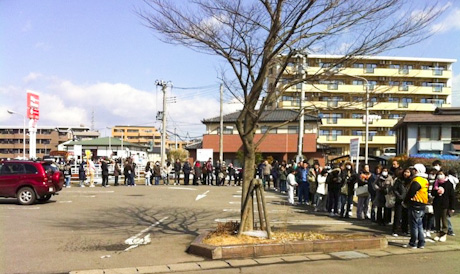
The above image was taken by a friend in Sendai, right in the middle of the earthquake zone. The people in the photo have been lining up patiently for hours on end for their ration of basic supplies. What’s remarkable is that everyone’s lining up with space to spare for everyone’s comfort. They’re not concerned about people cutting line – it just won’t happen.
I can’t imagine even seeing a 10-person line like this in an average fast food restaurant without people looking over shoulders or complaining about the service. I first noticed spacious lineups in Osaka, Japan at a newly opened Krispy Kreme store (see last Japan post), but to see it in a disaster region is something else.
Furthermore, people only took what they needed, and not hoarded as much as they could get. This is in stark contrast to some people’s reaction to say, the Y2K bug. Stealing and looting is almost non-existent. If we rewind bag to Japan’s last major earthquake in Kobe, the same contrast was evident in comparison to the L.A. riots which happened around the same time.
It’s our quest to be individualistic, or as I’ve heard many time before – “finding ourselves” – that the ego and our selfishness manifests itself. This shows up in Western concepts such as more is better, and constant, unsustainable economic or corporate growth.
More, more, more!
How about taking a zen approach where less is better? How about recognizing that there is a greater happiness than our own? Believe it or not, it feels good to be part of the humankind collective, to put ourselves secondary knowing it increases the Gross National Happiness. Understandably, my Japanese friends take pride in how their fellow nationals have responded in the aftermath.
Just poking at individualism sounds like the start of a communist manifesto, but it’s not. Creating too strong of an identity for ourselves is what causes us to differentiate, and thus separate, ourselves from one another, and with it creates conflict.
To see our common journey and unity seems a much more harmonious way to live than say, survival of the fittest. Some might say it’s too idealistic to work completely, but at the least, it seems much less stressful.
So let’s learn some things from the Japanese. Let’s wear surgical masks in public whenever we have a slight cold. Let’s live within our needs and not wants. Let’s live in a way where we are naturally considerate of others.
To conclude, I’d like to post something my friend Yusuke wrote from the Sendai earthquake region:
For 5 days, all I could was do something that does not require electricity such as reading books or playing card games. At the beginning of this inconvenient life, I felt bored.
Now, however, it is acceptable for me because I feel like I went back to my childhood and could find beautiful hearts that we have through helping each other. Also, on the street, I was surprised by absolutely fantastic stars because of the complete darkness. When we stop living as “human”, the earth changes itself to the nature. That was like a message from it to humans.
I have no question about that this earthquake will be a chance for us to think about what we are.
To help raise the spirits of my friends in Japan, I’ve launched a translation project to make risingbean.com in Japanese. Please share with your Japanese friends, and to my friends in Japan, stay strong and unite!


Leave a Reply