
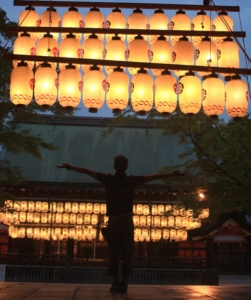
One’s destination is never a place, but a new way of seeing things.
-Henry MillerWhat is it about travel that causes one to gain insight and see the world from a different perspective? And, especially upon coming back, to cherish the experience even more all the while seeing day-to-day living much differently?
As an adventure traveler, I didn’t expect myself visiting Japan anytime soon because I considered it expensive and a super-safe tourist destination – I was saving Japan for retirement. Nonetheless, the winds of change took me there on short notice, so I decided to try living there to see what I could discover. I was pleasantly surprised to encounter some hurdles and get a total culture shock.
All too often, when we travel, we tend or impose our values on another culture or see a place through our eyes. This really limits our experience. By exercising some humility, we can gain so much more from traveling. At first glance from a Western point of view, one might say that in Japan, people work too hard, are too polite, and are backwards or closed-off because so few Japanese speak English. To find out more, I skipped the tourist hot-spots, bought a used bike to coast around town in, armed myself with a functional level of Japanese, and did my best to integrate myself into day-to-day life to see what I could learn.
Here are some things I picked up.
Healthy Habits
Firstly, barring sumo wrestlers, obesity and being overweight is not much of a problem in Japan. The portions are smaller there, NOT because the people are smaller – contrary to popular belief, Japanese people are not minuscule. I felt pretty normal there, though I’m not a giant either.
Small portions combined with good dietary habits mean that Japanese people don’t eat themselves into a coma. Instead, Japanese people tend to eat to a comfortable level – around 80% fullness, which is a fantastic habit.
Of course, times are changing as Western and Western-inspired fast food chains are popping up all over Japan. Check out the 3-hour lineup to get into the newly opened Krispy Kreme in Osaka – It continues in a longer, separate line a block away from where you are escorted to the main lineup!
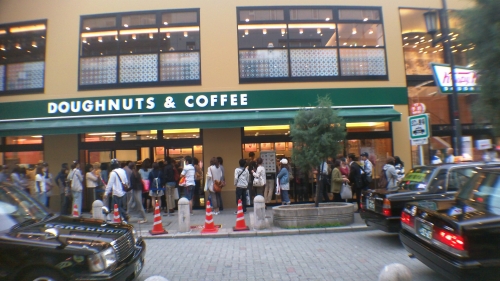
So yes, fast food is there, but it’s still not as common to be eating it as much as we do here. Moreover, typical fast food is generally healthier such as bowl of ramen or udon noodles, or convenience store onigiri (stuffed rice wrapped in seaweed) or microwaveable bento box.
Western or Eastern, I would also add to eat slowly. Because of a strong work culture in Japan, people do eat as fast, if not faster, than Westerners. I see people tuck in and out of ramen shacks during the busy half hour lunch break like a quick change magic act. So, I would add that if you do have time, eat slowly. I used to be a fast eater. Once I recognized the bad habit, I began to count the number of times I would chew before swallowing (around 30), and it rather quickly developed a slower eating habit (and I didn’t have to count anymore either!). Yes, sometimes my food gets cold or my friend finish their meals eons before me, but it doesn’t really bother me. I enjoy my food cold and fill any “eating gaps” with my friends by conversation.
If you eat slowly, you will kill two bird with one stone – you will develop a good eating habit and you will feel full faster. Biologically speaking, when we eat too fast, the hormones that cause us to feel full are released less and thus leads to overeating. More importantly, by eating slower we avoid the dreaded food-induced coma (or what some of us humorously call itis – watch Dave Chappelle to learn more) This is really important so you can stay productive after a meal!
Aside from food, Japanese people are much fitter. Going to the gym isn’t as common there, but there’s no need to. Walking, public transportation, and biking are the primary forms of getting around. I was at a water playpark yesterday with my son and really took notice of the excess amount of love handles around. It’s astonishing how much an impact living suburban living and car-dependency can cause on your physical health.
In Japan, the car is not king. Many low-rise apartments are built without garages. And believe it or not, I saw firsthand that you can bike until you’re 80 (or past that!).
The beauty of such good diets and fitness is that Japanese people aren’t trying to be healthy – it’s just ingrained into day-to-day life resulting in some of the longest life expectancy in the world. More importantly, being in good health results in a quality long life, not one confined by vehicles, drugs, electric wheelchairs, and other health-related worries. If you don’t have the luxury of “cultural fitness”, then either consider an urban or semi-urban living environment or start building healthy habits.
Incredible Politeness
Beyond food and fitness, what I learned most from Japan was observing the incredibly polite culture. In fact, it seems like Japan is the only polite culture left, though to be fair, there are several very friendly cultures remaining in the world. Prior to going to Japan, I was wondering why it seemed like for every phrase I learned, there seemed to be 3 or 4 ways to say it, each in more polite iterations. (e.g. “Thank You” – arigatou, arigatou gozaimasu, domo arigatou gozaimasu).
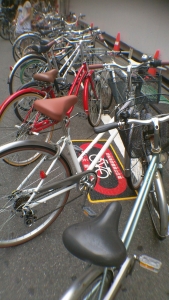
While learning the ropes and rules of biking around crowded, chaotic city streets, as well as “No Biking/Bike Parking” signs everyone ignored, I was never given a hard time by anyone. I’m sure I cut off many drivers, went the wrong way, rode too slow sometimes, rode too close to pedestrians, and pedaled through an outdoor pedestrian mall when I wasn’t supposed to. Yet I was never got honked at. I never got stared down. I was never cursed at. Never given a hard time. And this wasn’t because I looked like a lost foreigner. Upon arriving, I picked up some clothes that looked more “Osaka”, put away my sunglasses because locals consider it narcissistic, and tried my best to blend in.
And, a polite culture naturally accompanies an honest one. By pure clumsiness, I happened to leave both my phone and camera one morning on an express train. I wasn’t sure how I could recover it because there were so many trains running in Japan. Yet, somehow I knew that there was a very good chance that I would get my lost articles back and I was right. Twenty minutes later after discovering my loss, I’m at the Central Station recovering them.
Fast forward 3 weeks later on a bus in San Francisco. I leave my bag open and somehow “lose” my phone. Later in the evening, I call up my number, and the “finder” requests a reward. The finder actually turned out to be an interesting bunch of homeless vagabonds and I shrugged off the whole experience all the while smiling and humming Modest Mouse’s catchy song Float On in my head: Well, a fake Jamaican took every last dime with that scam. It was worth it just to learn some sleight-of-hand.
Unrelated Fun Points
Some other interesting tidbits from Japan:
Slurping is not rude. It’s the common way to eat your noodles, and they taste better when slurped.
Japanese drive on the left side of the road. Not the wrong side of the road
I also wondered why the most common umbrella was made of transparent plastic. Then it rained, I bought one, and rode my bike using the umbrella like a window.
The Abtronic is still legally sold here.
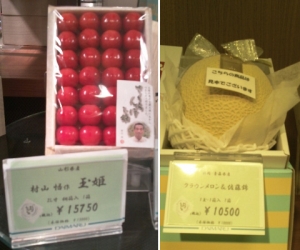
Japan is not as expensive as one might think. Sure, there are¥15750 ($150) gift cherries, ¥10500 ($100) gift melons, and other expensive gift fruit you can buy in department stores, but regular supermarket fruit costs more or less the same as North America. Sushi is much cheaper in the supermarkets. There’s also this nice chain I frequented, Lawson 100. It’s a dollar food store with good quality and fresh food!

However, vintage is expensive. You might want to take your old clothes with you to Japan and make some money. I spotted the above pair of refashioned vintage Levi 501’s sell at the Daimaru department store for over $730.
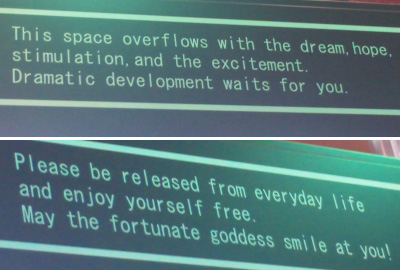
Finally, learning Japanese is really useful because English is almost non-existent there. A little Japanese can help a lot in terms of making friends and getting off the beaten path. Your stomach will also thank you when you check into an izakaya restaurant. This is not to say that Japanese don’t like English. On the contrary, it’s all over the place in a comical “Engrish” form! So until next time, I sign off with: Please be released from everyday life and enjoy yourself free. May the fortunate goddess smile at you!


Leave a Reply